Empirical and Molecular Formulas
The previous chapter treated a compound's formula as something simply given: told that a sample was or , the task was only to count atoms and moles. In practice, a chemist analysing an unknown substance has no such luxury — a formula must be worked out from experimental data, usually a measured mass or percentage of each element present. This chapter develops exactly that skill: turning raw mass data into a chemical formula, first in its simplest whole-number form (the empirical formula), and then, with one further piece of information, into the true molecular formula.
The central difficulty is that a mass in grams and a formula built from small whole-number subscripts live on completely different scales, and the mole, built in the last chapter, is precisely the tool that connects them. Converting a mass of each element into an amount in mol turns an experimental measurement into something directly comparable to a chemical formula's subscripts — themselves nothing more than a mole ratio. This chapter stays entirely within the world of formulas: no chemical equation is written or balanced here, and no reaction yield is calculated — both are the business of the next two chapters.
1. Percentage Composition by Mass
The percentage composition of a compound states what fraction of its total mass is contributed by each element, found from the compound's own molar mass.
where is the number of atoms of that element shown in the formula. Because and are both dimensionless ratios on the same relative scale, the units cancel completely and the result is a pure percentage, independent of the actual sample size.
Worked example. Find the percentage composition by mass of water, ().
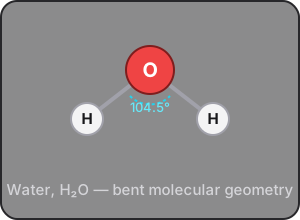
As a check, the two percentages must sum to (allowing for rounding): . This calculation runs in the "easy" direction — formula known, percentages found. The empirical formula problem that follows runs it in reverse.
Key distinction. Percentage composition describes a known compound. The empirical formula problem below starts from percentages (or masses) and works backward to find an unknown formula — the same relationship, used in the opposite direction.
2. The Empirical Formula
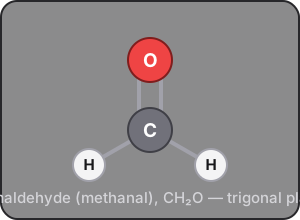
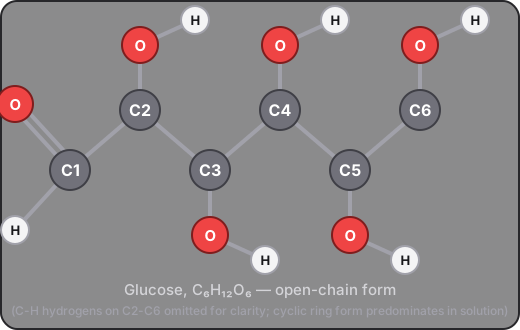
The empirical formula of a compound is the simplest whole-number ratio of atoms of each element present. It is not necessarily the compound's true formula: glucose, with molecular formula , shares the empirical formula with formaldehyde (, molecular formula itself) and with many other compounds besides — the empirical formula alone cannot distinguish between them. Determining it is nonetheless the essential first step, because it is exactly what a measurement of elemental composition by mass can directly reveal.
2.1 The procedure
Given either the mass or the percentage by mass of each element in a sample (the two are interchangeable, since percentage composition is simply the mass contributed by each element out of an assumed total), the empirical formula is found in four steps:
- Convert each mass (or percentage, treated as a mass out of ) to an amount in mol, using for each element in turn.
- Divide every mole value by the smallest one obtained, producing a ratio in which at least one element has become exactly .
- If any ratio is not close to a whole number, multiply every ratio by the smallest integer that clears the fraction (most often , or ; the common culprits are ratios ending in or ( or , cleared by ), or ( or , cleared by ), and (, cleared by )).
- Round the resulting ratios to the nearest whole numbers and write them as subscripts; a ratio that is only off by rounding error (e.g. or ) is accepted as the intended whole number.
Worked example. A compound contains carbon, hydrogen and oxygen by mass. Find its empirical formula.
Step 1 — convert each percentage (per ) to an amount in mol:
Step 2 — divide every value by the smallest, :
Step 3 — check for whole numbers. All three ratios are already acceptably close to whole numbers (), so no further scaling is needed.
Step 4 — round and write the formula:
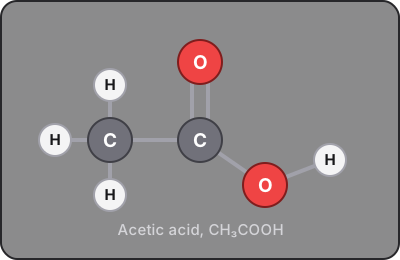
This is, in fact, the empirical formula shared by glucose, formaldehyde, and acetic acid — a reminder that the empirical formula alone never identifies a compound uniquely. The real structures below show just how different these three molecules actually are, despite sharing the same simplest ratio of atoms:
2.2 A deceptive 1:1 ratio
Worked example. A compound is found to contain of hydrogen and of oxygen. Find its empirical formula.
Step 1 — convert to moles:
Step 2 — divide by the smaller value, :
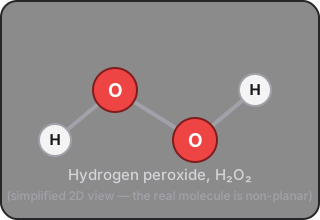
Both ratios round cleanly to whole numbers without any further scaling, giving the empirical formula — the empirical formula of hydrogen peroxide, (its own ratio reduces to the same ). This example is included specifically because a ratio of is often mistaken for "nothing to calculate"; the mole conversion must still be carried out, since the mass ratio (, roughly ) looks nothing like the final atom ratio.
Warning. Never skip the conversion to moles and attempt to read a formula directly from a mass or percentage ratio. Mass ratios and mole ratios coincide only when every element involved happens to have the same relative atomic mass, which is never assumed.
3. From Combustion Data to Percentage Composition
A common experimental route to percentage composition, especially for compounds containing only carbon, hydrogen and oxygen, is combustion analysis: a known mass of the compound is burned completely in excess oxygen, and the masses of and produced are measured.
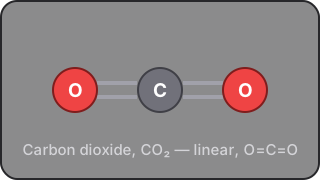 Every carbon atom in the original sample ends up in a molecule, and every hydrogen atom ends up in an molecule, so the masses of carbon and hydrogen in the original sample can be recovered from the masses of these products.
Worked example. Complete combustion of a sample of a hydrocarbon (a compound of carbon and hydrogen only) produces of and of . Find the empirical formula.
Step 1 — recover the mass of carbon, via the mole ratio inside ():
Step 2 — recover the mass of hydrogen, via the mole ratio inside (), remembering each water molecule carries two hydrogen atoms:
Step 3 — find the mole ratio directly, since the amounts in mol were already found along the way:
A ratio of is close to ; multiplying both values by gives , , so the empirical formula is . (As a check on the original data: the carbon mass, , plus the hydrogen mass, , sum to — matching the original sample to within the rounding of this calculation, exactly as conservation of mass requires for a compound containing only these two elements.)
4. From Empirical Formula to Molecular Formula
The empirical formula alone never fixes a compound's true, molecular formula — only its simplest atomic ratio. The molecular formula is always a whole-number multiple of the empirical formula:
Finding therefore requires one additional piece of experimental information beyond the empirical formula itself: the compound's actual molar mass, typically obtained from mass spectrometry or (for a gas) from its molar volume — both developed in later chapters of this block.
Worked example. A compound has empirical formula () and is found by mass spectrometry to have a molar mass of . Find its molecular formula.
This is glucose — the same compound used as a running example throughout this chapter, now uniquely identified once the extra piece of information (the molar mass) is supplied. Had the measured molar mass instead been , with , the molecular formula would have coincided exactly with the empirical formula, as it does for formaldehyde, .
Key distinction. The empirical formula is determined from composition data alone and is never sufficient by itself to identify a specific compound. The molecular formula additionally requires the compound's molar mass, and is the formula that correctly describes one real molecule.
5. Hydrated Salts and Water of Crystallization
Many ionic solids crystallize with a fixed number of water molecules locked into their crystal lattice, called water of crystallization. Such a compound is written with a raised dot separating the anhydrous formula from the number of water molecules per formula unit, for example (copper(II) sulfate pentahydrate). Finding this number, , in a general hydrate is a direct application of the same mole-ratio method used for an empirical formula, now applied to just two "components": the anhydrous salt and the water.
Heating a hydrated salt drives off the water of crystallization, leaving the anhydrous salt behind; measuring the mass lost gives the amount of water that was present, which is then compared with the amount of anhydrous salt remaining.
Worked example. A sample of hydrated magnesium sulfate, , is heated to constant mass, leaving of anhydrous (). Find .
Step 1 — find the mass, and then the amount, of water driven off:
Step 2 — find the amount of anhydrous salt remaining:
Step 3 — divide to find the mole ratio of water to salt:
The hydrate is therefore , Epsom salt — and rounds convincingly to the nearby whole number , consistent with the experimental rounding seen throughout this chapter.
6. Common Exam Pitfalls
- Reading a formula straight off a mass or percentage ratio, without converting to moles first. Mass ratios only equal mole ratios when every involved happens to be equal, which is never assumed.
- Stopping at a non-whole-number ratio instead of recognising a recurring decimal such as , or as a fraction that needs clearing by multiplying through.
- Confusing the empirical formula with the molecular formula, and quoting the former when the question explicitly supplies a molar mass and asks for the latter.
- Forgetting the factor of two for hydrogen when using combustion data. Each mole of produced corresponds to two moles of hydrogen atoms in the original sample, not one.
- Assuming the percentages of all elements are given. If a compound contains an element not explicitly measured (often oxygen), its mass or percentage must first be found by subtracting the others from the total.
- Not rounding the mole ratio to an integer in a hydrate calculation. A ratio of should be recognised as experimental scatter around and rounded accordingly, not reported (or worse, used further) as a non-integer number of water molecules.
Summary
- Percentage composition, , describes a known compound; the empirical formula problem runs this relationship in reverse.
- The empirical formula is the simplest whole-number atom ratio, found by converting each element's mass (or percentage) to moles, dividing through by the smallest value, and clearing any remaining fraction by a whole-number multiplier.
- Combustion analysis recovers the masses of carbon and hydrogen in a sample from the masses of and produced, remembering the factor of two for hydrogen hidden inside every water molecule.
- The molecular formula is a whole-number multiple, , of the empirical formula, and requires the compound's molar mass as an extra piece of data beyond composition alone.
- Water of crystallization in a hydrate is found by heating to drive off the water, then taking the mole ratio of water lost to anhydrous salt remaining.
- Writing and balancing full chemical equations — and using them to relate amounts of reactants and products in a reaction — are the subjects of the next two chapters.